Wednesday, September 22, 2010

Thursday, August 07, 2008
Moving to the City
I'm very excited because on Friday we're picking up key to our new apartment in Noe Valley in the city. No more long commutes, train passes, or obsessive internet browsing on iPhone. Now I get to ride the BART and spend two more hours of my life each day doing stuff I consider productive.
Tuesday, July 29, 2008
Sunday, July 20, 2008
My blog - dead and now alive again!
Life takes its twists and turns, and in the past year, I've realized I'm more mercurial than most MBAs.
On June 20, I resigned from my position at Apple and the next Monday started work at a software startup in San Francisco called Wallop. Whoa - I didn't realize how life could change so much. Here's a quick throwdown:
Apple vs Wallop, round I (ding!)
Offices vs One big room where everyone works
10,000 other people who do stuff vs 10 people who do stuff
On June 20, I resigned from my position at Apple and the next Monday started work at a software startup in San Francisco called Wallop. Whoa - I didn't realize how life could change so much. Here's a quick throwdown:
Apple vs Wallop, round I (ding!)
Offices vs One big room where everyone works
10,000 other people who do stuff vs 10 people who do stuff
Me thinking about doing stuff vs Me doing stuff
Silicon Valley suburbs vs. San Francisco
So you can see, after round I, it's a knockout for Wallop. The name does indeed pack a punch. So many other great qualities, too. Right now, I love my job. :-D
Check out an upcoming post where I will post our new company website - right now I'm working on it.
Along with my career move, Ari and I have taken the plunge and put away a car's worth of cash on a beautiful apartment in Noe Valley. Ok, maybe a cheap, used car's worth. Like mine. We'll be moving up to our new digs on August 8th.
And so, I've decided the blog must go on. Actually, after hearing lately that people actually read it, I have come to this realization. So thanks to Ajeeth Sankaran and his awesome wife (whom I haven't met but I'm sure is rad) and Nick Hoel for my kick in the butt to get going.
My motto this time: It's never too late for anything! Stick around for upcoming posts.
Thursday, June 28, 2007
Visiting the family Villages - Chonglou district, near Taishan in Guangdong Province
I will also have to do a lot of explaining, but here are the the videos and photos for those eager to get a glimpse of what my grandfather and grandmother's villages look like today (well, a little over a week ago).
Videos first:
Here is when we finally found Yeah-yeah's village by walking through a field of crops - we could barely see the gate from the road and had to finangle through some rows of crops just to get to the entrance. Yeah-yeah's house is the building on the left, and there are some farmers living there and one woman. This is my first approach - thankfully this guy was really friendly and actually let me go inside and see the place thoroughly.
These guys are helping us find Yeng-yeng's village by drawing maps in the sand. Our driver is in the blue shirt.
This is all I could post today - more coming!
Videos first:
Here is when we finally found Yeah-yeah's village by walking through a field of crops - we could barely see the gate from the road and had to finangle through some rows of crops just to get to the entrance. Yeah-yeah's house is the building on the left, and there are some farmers living there and one woman. This is my first approach - thankfully this guy was really friendly and actually let me go inside and see the place thoroughly.
These guys are helping us find Yeng-yeng's village by drawing maps in the sand. Our driver is in the blue shirt.
This is all I could post today - more coming!
China!
China.
So, it's been 9 days since I landed here in Zhongguo, and I feel terribly bad for putting my journaling off until now for two reasons: one, I've been lazy, and two, I think my English has deteriorated and my ego is at risk. Oh well. As for the latter concern, that kicks off this entry with the observation that NO ONE HERE SPEAKS ENGLISH, well, practically no one except our guides. This has upsides, for example, my Chinese has really improved and the experience has felt very authentic. We discovered this fact when arrived at our first hotel, a wonderfully new and clean place called the Novotel immediately adjacent to the Guangzhou Bai Yuan Int'l Airport. I was so excited by the modern room with western bath and aromatic soaps it was like Christmas (ha ha).
The next morning we took an early morning flight to Kunming in Yunnan province, where our trip really began. Since neither Ari nor I enjoy crowds, bars, late nights, or smoke that much, we decided that for this trip we would just skip the cities and go straight to the country side in tourist-popular forever spring Yunnan province. Of course, here in China a small city like Kunming still boasts 10M people, but it has an intimacy that is charming. It is navigable, clean, and inherently accessible. We met our tourguide, Leslie in the airport and took a car straight to the only AAAA tourist attraction we'd see on the entire trip, the Stone forest (Shi Lin), a park of 300sqkm that is pock-marked with large grey stones jutting up from the ground. It's a beautifully groomed place, and we were pretty tired so we took an electric bus and walked just some short distances.
Our guide Leslie, who was a chatty and sophisticated 21 year old told us about how Israelis frequently visit this area and are typically the most demanding tourists of them all. Apparently the previous week a large group had gotten into a fight (people literally pushing eachother around) when the local hawkers got a little too forceful. She showed us the exact location and we all laughed. That afternoon we tried our first authentic Chinese food and it involved choosing raw ingredients by sight to be cooked, a routine that was exercised several more times on the trip. We ended up with Pork with mushrooms and a green spinach-like vegetable stir fried with egg, and a large bowl of soup with some cured meats. We thought it was tasty, albeit a little expensive (85RMB, about $10). I was able to try out my Chinese by ordering a bottle of water and two glasses.
On the way back to Kunming, Leslie brought us to a family's shop (in a big house) where ladies were carefully stiching away at delicate thread covered paintings and exquisite silk rugs. That night after a nap, we ventured out of the hotel, tired and bedraggled from traveling, to get some dinner. This task proved more difficult than expected, seeing as I forgot my quick-reference book and only knew the words for bread, rice, dumpling, beef, and pork. We ended up getting adventurous at a small street-side restaurant with arms-length-diameter steamers, and discovered something that we loved but still don't know the word for (see pic).
The next morning we caught another flight and headed north toward the Himalayas to Dali, a town with dual personalities: modern and ancient. This region, Yunnan, is haven to more ethnic minorities than the rest of China combined, so we set out to learn more about them. The Naxi (na-shee) people are centered in this area, so we went to a touristy Naxi house and saw the three course tea and marriage ceremony recreated. Three course tea involves three teas, one bitter, one sweet, and one with everything but the kitchen sink, including cheese that is grated and some nuts. (bitter and sink ones pictured). We liked the second one best, with its spiced honeyed taste. The marriage recreation was also interesting - the bride actually wears sunglasses (and as Ari says, looks ridiculous) and a mirror hanging from her neck. As you can tell, we were entertained.
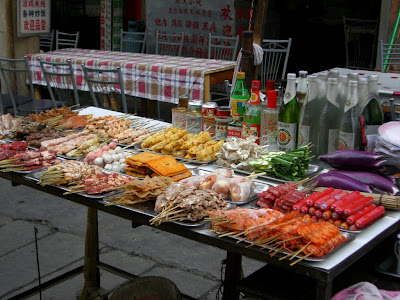
A typical restaurant where you choose your ingredients, while they're fresh, and then they cook it!

Street food:
Later that afternoon we visited the three pagodas and a gigundous Buddhist temple complex, all shiny and golden in the afternoon sun. I was in awe at the 40ft tall buddhas laden with gold in the numerous darkened temples. The doors in these places are people-sized, and the monuments god-sized, so it's difficult to imagine the possibility of even transporting one of the statues into each temple. The thresholds are 1-2ft high to prevent wandering ghosts from meandering in, which makes one feel a little athletic. Through the center doors go the monks, while the lowly tourists (myself) go in the side door. While we were there we heard chanting which sounded almost Gregorian in tune, and the air was muggy and rainy. One hall that was especially interesting for me housed 300 statues of monks (at an inferior level to that of the Buddha or other gods) from long ago until now. Monks were life-sized, and each with a resemblance to someone, perhaps even the monk himself. There were monks with large bellies, skinny as a rail, monks laughing with children climbing about them, monks with beards, monks with no hair at all, monks with musical instruments, with war tools, with mouths open in praise and quietly meditating. The stories of each of these characters were almost palpable, and recorded in a way that was formerly unknown to me: in sculpture.
We took an electric bus back through the ancient leaning pagodas (think Towers of Pisa) that miraculously seperated and reunited during the 1996 earthquake, and headed to town. Since it was our first ancient town, we were enthralled with the "old-China"ness of it all - ashen-coloured roofs curling up at the ends, dragon carvings, charcoal covered wood everywhere. We stopped in a tea shop for a sales pitch and sampled three teas as part of a complicated process: first, one has to wash the tea leaves three times with almost-boiling water, and wash the cups (small shot sized glasses) as well with the hot tea-like stuff, and then you can try it. In the shops they have these neat desks with a depressed area for splashing hot water and the tea about, and then a drain that heads secretly out of the back of the shop. We enjoyed the syrupy sweet ginseng zing and caffeine. Then we headed back to our hotel.
That evening we ventured into town along "Foreigner street" to find some food at a restaurant with an English menu. Unfortunately, this limited us quite a bit, because I found that even ordering the local specialty (fish in a hot pot with bean curd) was a bad idea. The best part of the meal was when an old woman tried to sell us some small hand-made dolls, and I asked her if she wanted the soup. She eagerly nodded and pulled out a plastic bag, in which she and I dumped the sizeable remaining contents of the soup (a whole fish, cabbage, beancurd, etc.) in to a flimsy slightly-leaking pink plastic bag. She left quickly and I hope she enjoyed the soup more than I did.
Dinner

Later that night we realized what a tourist trap we were in when the Chinese guests also staying at our hotel came back from whatever revelry they had been up to. The walls were thin and the guest were LOUD. All night. This theme unfortunately continued into LiJiang.
Drive to LiJiang

We awoke the next morning and drove another couple of hours to LiJiang. Our guide met us at the hotel and took us to Ancient Lijiang. From the highest point in town, one can see a yin and yang of construction - old blackened roof houses in the ancient part, and new alabaster-coloured commercial buildings in the new. Unfortunately, the place significantly loses its romance when you learn that entire place was reconstructed in 1996 after the massive earthquake that tumbled all the buildings to the ground.
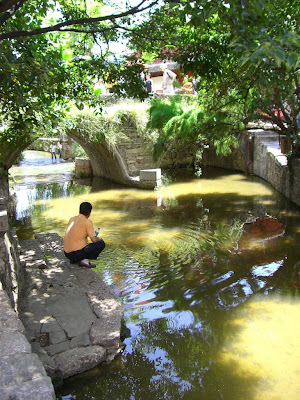
Anyway, back in the ancient city, we were a little puzzled - weren't we just in this place in Dali? It looked exactly the same. Our guide took us on a walk through the city explaining the geography of the place, with its heartspring of water and unique well systems - water was recycled completely efficiently at one point, with drinking water, dish-washing water, and clothes-washing water all coming from the same place. Now, ancient water ways line all the stone paths so that tourists can find their way around; if you're ever lost, just head upwater and you'll reach the center of town at the water wheel.
LiJiang waterway
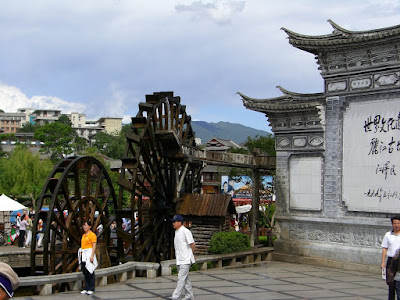
Water wheels in LiJiang
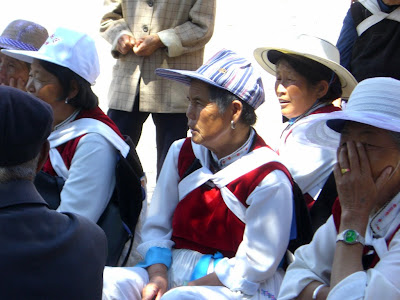
Dai minority women in LiJiang square
Waterway in the square
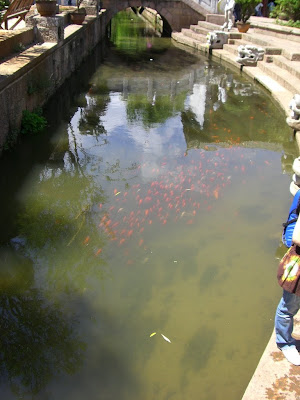
Longevity Bridge - supposedly a guy who lived here hundreds of years ago lived for hundreds of years.
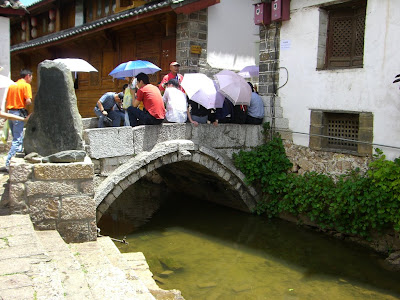
On the way to Lion Hill

We also climbed to the top of Lion Hill for a good look down on the two-faced city and the mountains that surround it. The Chinese are keen on noting the likeness of natural formations and other inatimate objects. The peaks that surround LiJiang are said to resemble a Jade Dragon Snow Mountain and a divot for holding a paintbrush. Since the roofs of ancient LiJiang are also blackened, its said that the city is like an ink slab for a giant god-sized artist. That night we ventured back into the ancient town to find a raucous scene that reminded Ari of Thailand. Dancing girls in bars shouting at eachother and into the crowd in mock competition, Chinese tourists everwhere, and really bad food. At this point we realized that something I was eating was really getting to me (more on that later) and skiddadled back to our hotel for some shuteye.
at the top of Lion Hill
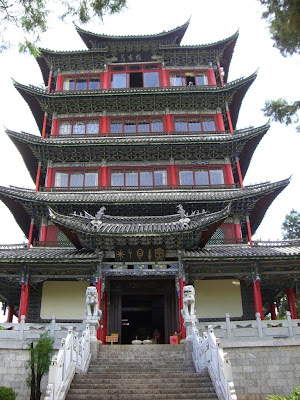
The "Ink Slab" (ancient city)

LiJiang new city
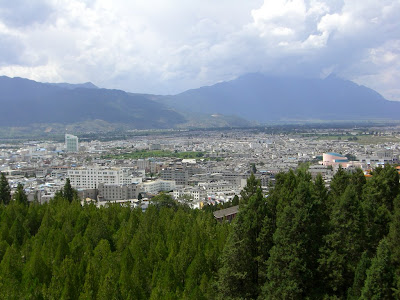
The mountain where you rest your paintbrush:

Tourists putting lotus flowers to float down the waterways

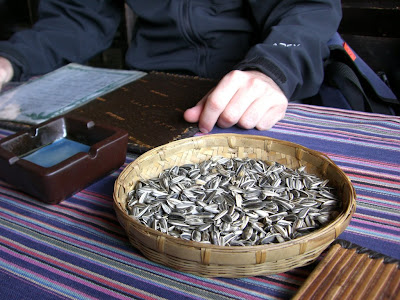
Sunflower seeds: an international pastime:
The next day we headed up to Jade Dragon Snow Mountain, which tops 5900 meters (19,350 ft) Ok, for those of you who have ever been to a mountain in North America, this is really really high. I forgot to mention that even in LiJiang at Lion Hill, we were dramatically huffing and puffing up the stairs. Here, we really had to take it easy. Fortunately, the park as a wonderfully long and peaceful ski-lift that you take up to a mountain meadow (pictured).

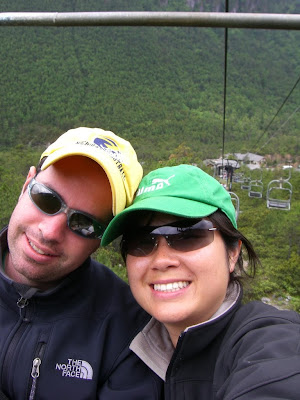
Small crimson lace fringed hearts on long strings are are hung in the trees and the forest is quiet. Also, we happened to arrive at a time when the minimal number of Chinese tourists were also there: lunchtime. We began to like our guide even more. We headed to a green mountain meadow where young couples used to commit suicide when they could not be with the one they loved but instead their betrothed. The mountain is much closer from here, too, yet shrouded in a cloud like it is all summer. It also began to rain but in the warm air the wetness was not so bad. The Chinese tourists had a different attitude about this, and acted almost allergic to the rain. It started to really come down in blustery winds when it was time for us to take the ski-lift down, but we decided to be adventourous and get wet. Our tourguide followed with her umbrella (pictured). Once we got to the bottom, we were pretty soaked and ready to head back to town.

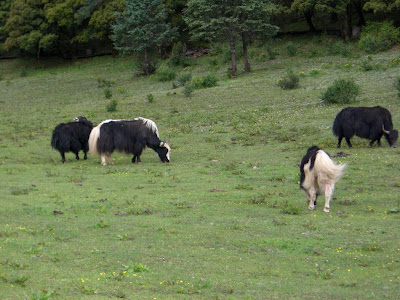
Yaks in the meadow
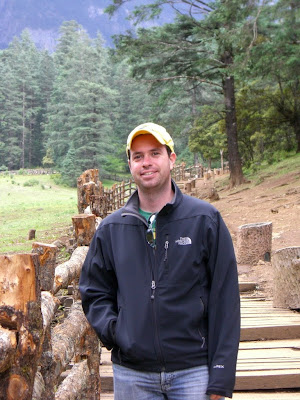

We were the only ones without an umbrella :-)

That evening our guide suggested that we visit a local dumpling shop called Northeastern King Wang's Dumplings right near our hotel, and I did my best at navigating the all-Chinese menu. We ordered 30 dumplings and two huge bowls of fried rice for just 22RMB (about $3). Unfortunately, we also discovered what was making me sick for the last three days: MSG. The dumplings were laden with them. 10 days later now and I'm still recovering. So goes it.
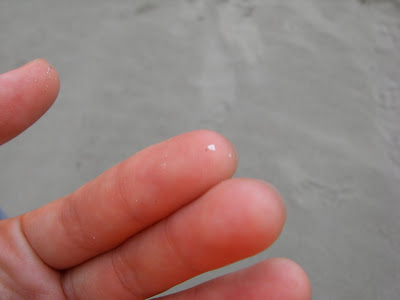
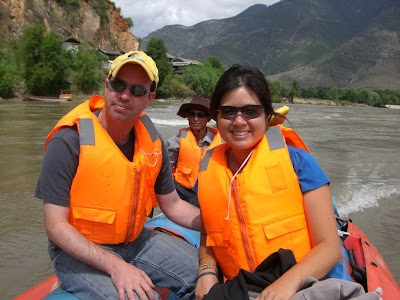
Finally somewhat accustomed to the altitude and eager to get out of the tourist jungle, we kep driving north with our trusty Muslim driver and fancy new car (a VW with just 16K miles) towards Zhongdian (Shangrila). We saw tobacco fields aplenty, and lots of other crops too, including corn, rice, apples, melon, etc. As part of the journey, we decided to take a hot-dog shaped raft 18km through the first bend of the Yangtze river, where the river bloats and swells its brown mass around a bend and heads north for the first time. Ari and I were eager for a substitute for the car (despite the fact that we really liked our driver) and it was lovely to get some fresh air and see things from a different perspective. We stopped at a sandy mound in the middle of the river, infamous for its gold-flecks (pictured). After about 18km, we stopped at a random sandy bank and hiked up a couple of switchbacks to actually find our driver waiting at the right spot. Our guide gave me a couple of peaches to try, which were at the height of their season and apparently a new variety with less fuzz. They were crisp with white and pink flesh, an quite delicious.

At the stone drum (an ancient tablet)
Rafting in the Yangtze
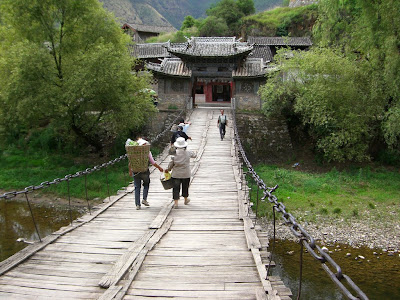
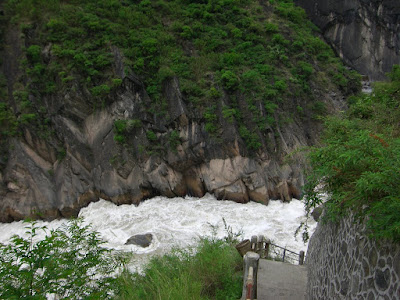
We met our next guide at a road-crossing near Tiger Leaping Gorge and had some "without MSG" lunch with him. We visited Tiger leaping gorge (where the Yangtse rushes through a 5000ft tall ravine with great fanfare, spraying up over boulders the size of a house) down approx 800 stairs, and made it back up on our own. Men wait along the way with unglamourous chariots and you can't turn a corner without seeing a makeshift shop with trinkets and other junk.

Markedly different from our other guides in manner and in looks, this guide explained that he was Tibetan. It was pretty amazing for us to see the dramatic differences once we had passed from LiJiang county into Shangrila. First was the smiles - everyone had one for eachother, and our guide took pains to give a smile warm handshake to each person we met. Second was the ruggedness of the land, people, and their lifestyle. Structures went from being small and stone to large, wooden, and seemingly full of warmth - Tibetan houses are large boxes, three stories tall, rectangular shaped, where the animals live on the ground floor during the winter, heating the human quarters above. The top level stores the wheat and grain, and a large open chute makes it easier to distribute to the people and animals below. The landscape also made us feel that we were in a new world - wide grassy expanses with ubiquitous black and white longhaired yaks, the chilling pristine mountain air, farmers with reddened leathery faces. Stick-made structures that resemble a shoddy wooden chair dot the landscape - 30ft tall, structures that keep and dry the wheat during the winter so it can be distributed to livestock. "Buddha hearts" (pictured) also accompany the road to keep drivers safe.


To be continued...at a later date...
So, it's been 9 days since I landed here in Zhongguo, and I feel terribly bad for putting my journaling off until now for two reasons: one, I've been lazy, and two, I think my English has deteriorated and my ego is at risk. Oh well. As for the latter concern, that kicks off this entry with the observation that NO ONE HERE SPEAKS ENGLISH, well, practically no one except our guides. This has upsides, for example, my Chinese has really improved and the experience has felt very authentic. We discovered this fact when arrived at our first hotel, a wonderfully new and clean place called the Novotel immediately adjacent to the Guangzhou Bai Yuan Int'l Airport. I was so excited by the modern room with western bath and aromatic soaps it was like Christmas (ha ha).
The next morning we took an early morning flight to Kunming in Yunnan province, where our trip really began. Since neither Ari nor I enjoy crowds, bars, late nights, or smoke that much, we decided that for this trip we would just skip the cities and go straight to the country side in tourist-popular forever spring Yunnan province. Of course, here in China a small city like Kunming still boasts 10M people, but it has an intimacy that is charming. It is navigable, clean, and inherently accessible. We met our tourguide, Leslie in the airport and took a car straight to the only AAAA tourist attraction we'd see on the entire trip, the Stone forest (Shi Lin), a park of 300sqkm that is pock-marked with large grey stones jutting up from the ground. It's a beautifully groomed place, and we were pretty tired so we took an electric bus and walked just some short distances.
Our guide Leslie, who was a chatty and sophisticated 21 year old told us about how Israelis frequently visit this area and are typically the most demanding tourists of them all. Apparently the previous week a large group had gotten into a fight (people literally pushing eachother around) when the local hawkers got a little too forceful. She showed us the exact location and we all laughed. That afternoon we tried our first authentic Chinese food and it involved choosing raw ingredients by sight to be cooked, a routine that was exercised several more times on the trip. We ended up with Pork with mushrooms and a green spinach-like vegetable stir fried with egg, and a large bowl of soup with some cured meats. We thought it was tasty, albeit a little expensive (85RMB, about $10). I was able to try out my Chinese by ordering a bottle of water and two glasses.
On the way back to Kunming, Leslie brought us to a family's shop (in a big house) where ladies were carefully stiching away at delicate thread covered paintings and exquisite silk rugs. That night after a nap, we ventured out of the hotel, tired and bedraggled from traveling, to get some dinner. This task proved more difficult than expected, seeing as I forgot my quick-reference book and only knew the words for bread, rice, dumpling, beef, and pork. We ended up getting adventurous at a small street-side restaurant with arms-length-diameter steamers, and discovered something that we loved but still don't know the word for (see pic).
The next morning we caught another flight and headed north toward the Himalayas to Dali, a town with dual personalities: modern and ancient. This region, Yunnan, is haven to more ethnic minorities than the rest of China combined, so we set out to learn more about them. The Naxi (na-shee) people are centered in this area, so we went to a touristy Naxi house and saw the three course tea and marriage ceremony recreated. Three course tea involves three teas, one bitter, one sweet, and one with everything but the kitchen sink, including cheese that is grated and some nuts. (bitter and sink ones pictured). We liked the second one best, with its spiced honeyed taste. The marriage recreation was also interesting - the bride actually wears sunglasses (and as Ari says, looks ridiculous) and a mirror hanging from her neck. As you can tell, we were entertained.
A typical restaurant where you choose your ingredients, while they're fresh, and then they cook it!
Street food:
Later that afternoon we visited the three pagodas and a gigundous Buddhist temple complex, all shiny and golden in the afternoon sun. I was in awe at the 40ft tall buddhas laden with gold in the numerous darkened temples. The doors in these places are people-sized, and the monuments god-sized, so it's difficult to imagine the possibility of even transporting one of the statues into each temple. The thresholds are 1-2ft high to prevent wandering ghosts from meandering in, which makes one feel a little athletic. Through the center doors go the monks, while the lowly tourists (myself) go in the side door. While we were there we heard chanting which sounded almost Gregorian in tune, and the air was muggy and rainy. One hall that was especially interesting for me housed 300 statues of monks (at an inferior level to that of the Buddha or other gods) from long ago until now. Monks were life-sized, and each with a resemblance to someone, perhaps even the monk himself. There were monks with large bellies, skinny as a rail, monks laughing with children climbing about them, monks with beards, monks with no hair at all, monks with musical instruments, with war tools, with mouths open in praise and quietly meditating. The stories of each of these characters were almost palpable, and recorded in a way that was formerly unknown to me: in sculpture.
We took an electric bus back through the ancient leaning pagodas (think Towers of Pisa) that miraculously seperated and reunited during the 1996 earthquake, and headed to town. Since it was our first ancient town, we were enthralled with the "old-China"ness of it all - ashen-coloured roofs curling up at the ends, dragon carvings, charcoal covered wood everywhere. We stopped in a tea shop for a sales pitch and sampled three teas as part of a complicated process: first, one has to wash the tea leaves three times with almost-boiling water, and wash the cups (small shot sized glasses) as well with the hot tea-like stuff, and then you can try it. In the shops they have these neat desks with a depressed area for splashing hot water and the tea about, and then a drain that heads secretly out of the back of the shop. We enjoyed the syrupy sweet ginseng zing and caffeine. Then we headed back to our hotel.
That evening we ventured into town along "Foreigner street" to find some food at a restaurant with an English menu. Unfortunately, this limited us quite a bit, because I found that even ordering the local specialty (fish in a hot pot with bean curd) was a bad idea. The best part of the meal was when an old woman tried to sell us some small hand-made dolls, and I asked her if she wanted the soup. She eagerly nodded and pulled out a plastic bag, in which she and I dumped the sizeable remaining contents of the soup (a whole fish, cabbage, beancurd, etc.) in to a flimsy slightly-leaking pink plastic bag. She left quickly and I hope she enjoyed the soup more than I did.
Dinner
Later that night we realized what a tourist trap we were in when the Chinese guests also staying at our hotel came back from whatever revelry they had been up to. The walls were thin and the guest were LOUD. All night. This theme unfortunately continued into LiJiang.
Drive to LiJiang
We awoke the next morning and drove another couple of hours to LiJiang. Our guide met us at the hotel and took us to Ancient Lijiang. From the highest point in town, one can see a yin and yang of construction - old blackened roof houses in the ancient part, and new alabaster-coloured commercial buildings in the new. Unfortunately, the place significantly loses its romance when you learn that entire place was reconstructed in 1996 after the massive earthquake that tumbled all the buildings to the ground.
Anyway, back in the ancient city, we were a little puzzled - weren't we just in this place in Dali? It looked exactly the same. Our guide took us on a walk through the city explaining the geography of the place, with its heartspring of water and unique well systems - water was recycled completely efficiently at one point, with drinking water, dish-washing water, and clothes-washing water all coming from the same place. Now, ancient water ways line all the stone paths so that tourists can find their way around; if you're ever lost, just head upwater and you'll reach the center of town at the water wheel.
LiJiang waterway
Water wheels in LiJiang
Dai minority women in LiJiang square
Waterway in the square
Longevity Bridge - supposedly a guy who lived here hundreds of years ago lived for hundreds of years.
On the way to Lion Hill
We also climbed to the top of Lion Hill for a good look down on the two-faced city and the mountains that surround it. The Chinese are keen on noting the likeness of natural formations and other inatimate objects. The peaks that surround LiJiang are said to resemble a Jade Dragon Snow Mountain and a divot for holding a paintbrush. Since the roofs of ancient LiJiang are also blackened, its said that the city is like an ink slab for a giant god-sized artist. That night we ventured back into the ancient town to find a raucous scene that reminded Ari of Thailand. Dancing girls in bars shouting at eachother and into the crowd in mock competition, Chinese tourists everwhere, and really bad food. At this point we realized that something I was eating was really getting to me (more on that later) and skiddadled back to our hotel for some shuteye.
at the top of Lion Hill
The "Ink Slab" (ancient city)
LiJiang new city
The mountain where you rest your paintbrush:
Tourists putting lotus flowers to float down the waterways
Sunflower seeds: an international pastime:
The next day we headed up to Jade Dragon Snow Mountain, which tops 5900 meters (19,350 ft) Ok, for those of you who have ever been to a mountain in North America, this is really really high. I forgot to mention that even in LiJiang at Lion Hill, we were dramatically huffing and puffing up the stairs. Here, we really had to take it easy. Fortunately, the park as a wonderfully long and peaceful ski-lift that you take up to a mountain meadow (pictured).
Small crimson lace fringed hearts on long strings are are hung in the trees and the forest is quiet. Also, we happened to arrive at a time when the minimal number of Chinese tourists were also there: lunchtime. We began to like our guide even more. We headed to a green mountain meadow where young couples used to commit suicide when they could not be with the one they loved but instead their betrothed. The mountain is much closer from here, too, yet shrouded in a cloud like it is all summer. It also began to rain but in the warm air the wetness was not so bad. The Chinese tourists had a different attitude about this, and acted almost allergic to the rain. It started to really come down in blustery winds when it was time for us to take the ski-lift down, but we decided to be adventourous and get wet. Our tourguide followed with her umbrella (pictured). Once we got to the bottom, we were pretty soaked and ready to head back to town.
Yaks in the meadow
We were the only ones without an umbrella :-)
That evening our guide suggested that we visit a local dumpling shop called Northeastern King Wang's Dumplings right near our hotel, and I did my best at navigating the all-Chinese menu. We ordered 30 dumplings and two huge bowls of fried rice for just 22RMB (about $3). Unfortunately, we also discovered what was making me sick for the last three days: MSG. The dumplings were laden with them. 10 days later now and I'm still recovering. So goes it.
Finally somewhat accustomed to the altitude and eager to get out of the tourist jungle, we kep driving north with our trusty Muslim driver and fancy new car (a VW with just 16K miles) towards Zhongdian (Shangrila). We saw tobacco fields aplenty, and lots of other crops too, including corn, rice, apples, melon, etc. As part of the journey, we decided to take a hot-dog shaped raft 18km through the first bend of the Yangtze river, where the river bloats and swells its brown mass around a bend and heads north for the first time. Ari and I were eager for a substitute for the car (despite the fact that we really liked our driver) and it was lovely to get some fresh air and see things from a different perspective. We stopped at a sandy mound in the middle of the river, infamous for its gold-flecks (pictured). After about 18km, we stopped at a random sandy bank and hiked up a couple of switchbacks to actually find our driver waiting at the right spot. Our guide gave me a couple of peaches to try, which were at the height of their season and apparently a new variety with less fuzz. They were crisp with white and pink flesh, an quite delicious.
At the stone drum (an ancient tablet)
Rafting in the Yangtze
We met our next guide at a road-crossing near Tiger Leaping Gorge and had some "without MSG" lunch with him. We visited Tiger leaping gorge (where the Yangtse rushes through a 5000ft tall ravine with great fanfare, spraying up over boulders the size of a house) down approx 800 stairs, and made it back up on our own. Men wait along the way with unglamourous chariots and you can't turn a corner without seeing a makeshift shop with trinkets and other junk.
Markedly different from our other guides in manner and in looks, this guide explained that he was Tibetan. It was pretty amazing for us to see the dramatic differences once we had passed from LiJiang county into Shangrila. First was the smiles - everyone had one for eachother, and our guide took pains to give a smile warm handshake to each person we met. Second was the ruggedness of the land, people, and their lifestyle. Structures went from being small and stone to large, wooden, and seemingly full of warmth - Tibetan houses are large boxes, three stories tall, rectangular shaped, where the animals live on the ground floor during the winter, heating the human quarters above. The top level stores the wheat and grain, and a large open chute makes it easier to distribute to the people and animals below. The landscape also made us feel that we were in a new world - wide grassy expanses with ubiquitous black and white longhaired yaks, the chilling pristine mountain air, farmers with reddened leathery faces. Stick-made structures that resemble a shoddy wooden chair dot the landscape - 30ft tall, structures that keep and dry the wheat during the winter so it can be distributed to livestock. "Buddha hearts" (pictured) also accompany the road to keep drivers safe.
To be continued...at a later date...
Sunday, June 17, 2007
India.
Week in India
Yep, see, I was in India!

Before I begin with tales of India, I have to let readers know just how hot it was there. When I arrived at 5:30am June 3rd, it was a cool 40C, but at daytime visits to Jaipur, Delhi, and Agra, the temperature soared to 50C. In case you've never been in such extreme heat, let me describe how it feels. First, you sweat, alot, and everywhere. Second, you have to move slowly as to not build up more heat, and third, all your aches and pains are amplified because of general uncomfortability. Secretly, though, I wanted to see if I was up to snuff and could deal with the sweltering temperatures. And turns out, I could! We were outside at least a couple of hours each day and I did just fine. However, I would not recommend traveling here at this time because it makes things generally unpleasant.
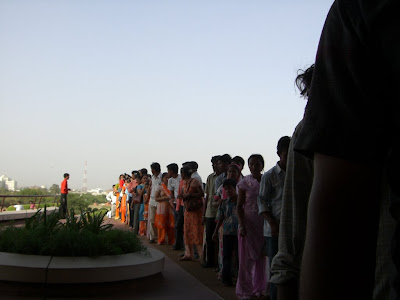
Line to get into the Ba'hai temple, this time in Delhi (I also saw one in Israel!)
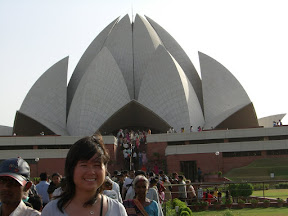
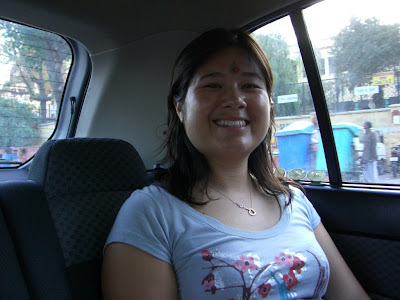
The first day I met up with Sam and we chatted over breakfast, a light fluffy salty mixture of pressed rice flakes, potatoes, and shredded carrots with lime. At Sam's place, she has an excellent cook who will prepare practically anything you like on demand. With Sam's and his efforts, I didn't get sick even once while I was there for the week. That afternoon we visited some local Delhi sights, which surprisingly were also new to Sam and her cousin Vikas. The next day we visited a Ba'hai temple and a Hindu temple too, where Sam showed me the local customs and I was blessed by a few priests.
After being blessed in the Hindu temple:
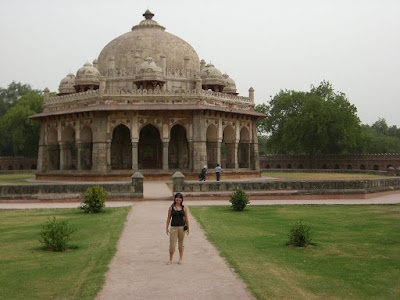
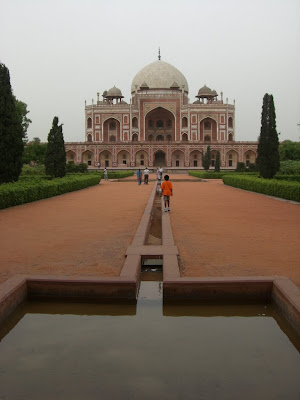
Moselm Tomb site in Delhi:

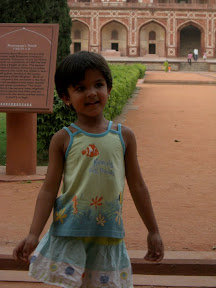
Sam's niece, Shrishti, and nephew Shiveth:

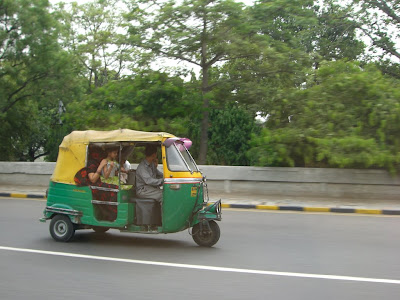
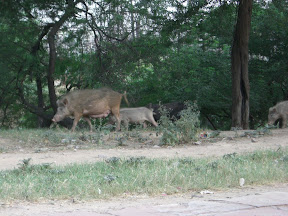
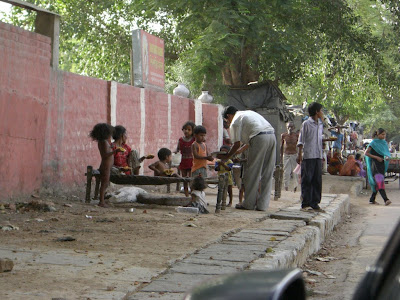
Frankly though, driving through the streets of Delhi was interesting enough for me. I had heard of the people piled into small cars, beggar children on the street, and millions of small three-wheeled taxicabs, but there's nothing like seeing the real thing right next to you on the asphalt. The amount of trash around was less than I had anticipated, but I still thought rather had thoughts of CK's sachets of detergen/Bottom of the Pyramid business ideas with a tinge of disgust - instead of focusing on selling stuff to these people, it is probably more important to ensure the right to education, safety, food and shelter first. I was astonished by the lack of literacy and hunger, in particular.
Here is where I learned to say "no", which I had been practicing in Israel. For Americans, "no" is practically unused - always cushioned with lots of softening phrases, like "no, not now" or "maybe later" or "not really" but in India, one has to learn to say "no" without anything else. For the first four days "no" was easy; I imagined myself a newsreporter just looking around and documenting things (mentally) without responsibility for anyone who may be suffering around me. But later in the week, it started to get to me - the vast expanse of wealth that lay between me and the rest of the people around me - and I started to get uncomfortable. "No" just didn't cut it anymore - I started to give food to those who were hungry and want to teach those who couldn't read. It was frustrating.
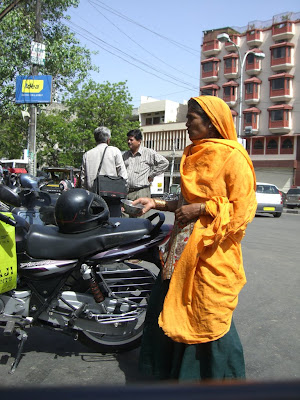
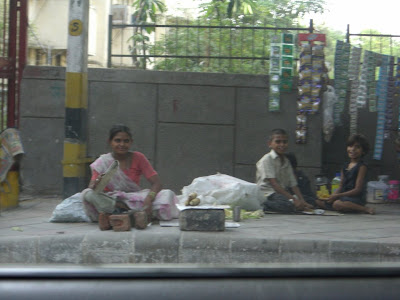
A beggar in Jaipur - she just finished knocking at our window for 5 min until a policeman shushed her away:
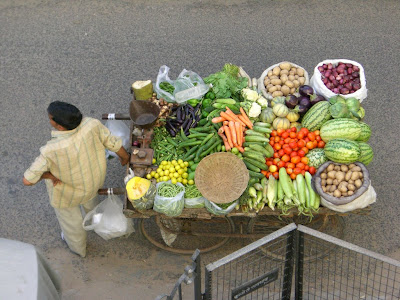
Since most of the population in India is so unskilled, the service industry booms. Here is a photo of a vegetable cart that comes right by Sam's house - one comes by every couple of hours - and the seller shouts his wares - you can buy right there on the spot. Another part of this service culture that I found peculiar is the utter dependence that one has on it. For instance, in order to ride in a car, you absolutely need a driver - a trained one - and so if the driver is off duty, you're pretty much stuck in the house. Also, it is not safe for women to travel alone, so we were always accompanied by a driver or Sam's cousin.
Vegetable cart at Sam's apartment (view from the balcony)
The service at Sam's apartment was phenomenal - particularly the food. Each item was made to our taste - with more or less salt, spice, oil, temperature etc. I ate like a princess and enjoyed every bite, which is good because here in China my system is having more difficulty. A couple of things that surprised me were 1) salty drinks, which are made with sulfur salt - the sulfur smelling a little of rotten eggs or hot springs, whichever you've experienced more 2) the lack of uncooked veggies, which may have been particular to Sam's house and 3) the sheer tastiness and variety of food that can be made with just vegetables.
Midway through the week I went with Vikas and his son to Jaipur, part of the trifecta of cities in the Delhi area: Jaipur, Delhi, and Agra. Jaipur is the capital of Rajastan, with a rich cultural and military history. The four hour drive on the way there was very exciting for me as I have never experienced any sort of driving and traffic remotely as hectic as this; people, cows, dogs, camels, water buffalo, horses, motorscooters, three-wheel taxis, trucks, buses and other cars litter the highway for the entire span, some going in the wrong direction, or crossing at inconvenient times (especially the cows) so the driver has to be especially alert...for four hours. Not an easy task. Once in Jaipur we visited the local sights - the iconic Hawa Mahal (pronounced Mah-hehl, meaning: palace of the wind) with cloistered rooms for the 20-odd wives and concubines of local royalty, and Amber fort (Ah-mer), home to the Rajastani government with an active Hindu temple. We stayed over night at Sam's aunt's place, a large house with several rooms but (unfortunately) fewer working A/C's.
Local traffic:


Highly decorated trucks


Our tourguide at Hawa Mahel

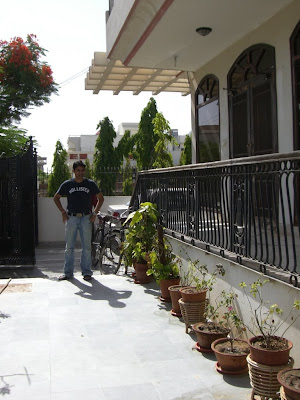
Sam's cousin Adarsh at his house in Jaipur:
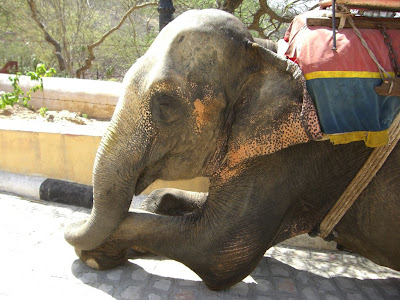
The elephant we rode - they actually kneel so you can get on, which is no easy task:
The ubiquitous me riding an elephant shot:

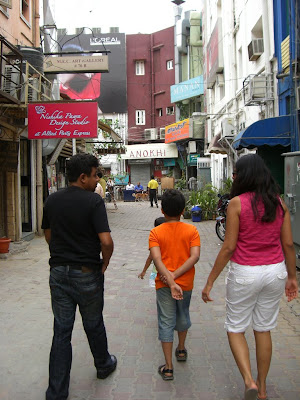
Back in Delhi we visited Dilly Hat, a market of cultural handicrafts from states all over India. We did some great shopping there and I went a little crazy stocking up on beautifully embroidered shawls and interesting necklaces, among other things. I began to get a little homesick and made sure I caught the daily episodes of Friends and Seinfeld. Sam and I had some great talks about life and the future. That evening Mohit arrived, back from trekking in the Himalayas with just a small backpack and sunburned lips. We hung out with him until 4am that night (!) despite our trip the next day to Agra.
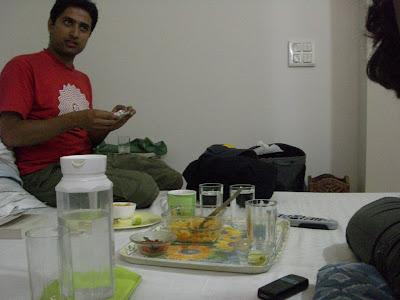
Mohit having some of the fluffy stuff I liked but cannot remember the name of:
Sam and Me in Dilly Hat:

Painting in Dilly Hat:
By the time we reached Agra, the temperature had reached about 50C (122F) and we couldn't leave the A/C of the car. We spent an hour or so in a local restaurant (called Indiana, which I found particularly entertaining), enjoyed ice cream and water before heading to the Taj Mahal (also pronounced Mah-hel).
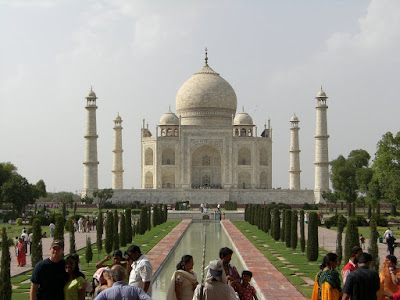
The beauty of the Taj is like nothing else I've ever seen - the proportions exquisite and the craftsmanship equally divine. It's too bad that it's just a tomb and that no one, in the history of time, has ever lived there. Even on this extremely hot day, there was a small crowd of tourists everywhere, and the Desis (Indians) do not treat the place with grace - many flagrantly disregard the signs to stay off the grass or take off your shoes, and inside, children shout unceremoniously with their parents looking on. The government has cordened off a ring around Agra where gas-guzzling vehicles cannot traverse, so we had to take a horse drawn cart to get close, and then walked the remainder of the way.
Picture from the cart:



On the way back as we were nearing our car, a boy wanted to sell me a keychain with a small white plastic Taj in a globe of water with sparkles in it - he wanted 100 rupees but I offered 50 (the equivalent of about 11 cents), and he took it, then then proceeded to hand all 7 of his keychains over to me. (I had only intended to buy one). So much for bargaining. After pawning a couple off to Sam's niece and nephew, and their maid, I returned the remaining ones to him, and he was happy. I breathed a sigh of relief when we climbed into the car for the ride back to Delhi.
The next morning I woke up, said goodbye to Sam, and departed for the Delhi airport at 6am. I flew to Bangkok with India Air, and met Ari (after some complications - I had to go through immigration to get my bag and then re-check-in to my China Southern flight, and we missed eachother for about 2.5 hours) and we flew together to Guangzhou.
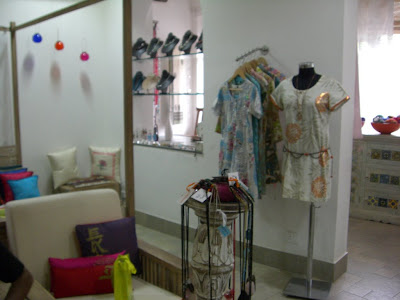
Sam's shop (MANAN) in Delhi:
Yoga at Sam's house:

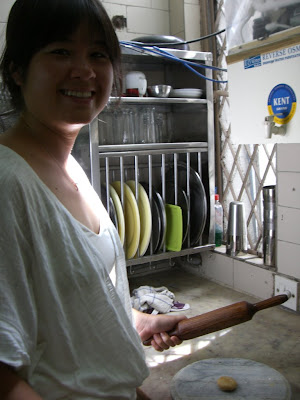
We made "poori" (fried bread with potatoes) and passed it out to some poor kids (note: there is no air conditioning in the kitchen, so it was about 100F in there)


some happy kids with lunch:
Yep, see, I was in India!
Before I begin with tales of India, I have to let readers know just how hot it was there. When I arrived at 5:30am June 3rd, it was a cool 40C, but at daytime visits to Jaipur, Delhi, and Agra, the temperature soared to 50C. In case you've never been in such extreme heat, let me describe how it feels. First, you sweat, alot, and everywhere. Second, you have to move slowly as to not build up more heat, and third, all your aches and pains are amplified because of general uncomfortability. Secretly, though, I wanted to see if I was up to snuff and could deal with the sweltering temperatures. And turns out, I could! We were outside at least a couple of hours each day and I did just fine. However, I would not recommend traveling here at this time because it makes things generally unpleasant.
Line to get into the Ba'hai temple, this time in Delhi (I also saw one in Israel!)
The first day I met up with Sam and we chatted over breakfast, a light fluffy salty mixture of pressed rice flakes, potatoes, and shredded carrots with lime. At Sam's place, she has an excellent cook who will prepare practically anything you like on demand. With Sam's and his efforts, I didn't get sick even once while I was there for the week. That afternoon we visited some local Delhi sights, which surprisingly were also new to Sam and her cousin Vikas. The next day we visited a Ba'hai temple and a Hindu temple too, where Sam showed me the local customs and I was blessed by a few priests.
After being blessed in the Hindu temple:
Moselm Tomb site in Delhi:
Sam's niece, Shrishti, and nephew Shiveth:
Frankly though, driving through the streets of Delhi was interesting enough for me. I had heard of the people piled into small cars, beggar children on the street, and millions of small three-wheeled taxicabs, but there's nothing like seeing the real thing right next to you on the asphalt. The amount of trash around was less than I had anticipated, but I still thought rather had thoughts of CK's sachets of detergen/Bottom of the Pyramid business ideas with a tinge of disgust - instead of focusing on selling stuff to these people, it is probably more important to ensure the right to education, safety, food and shelter first. I was astonished by the lack of literacy and hunger, in particular.
Here is where I learned to say "no", which I had been practicing in Israel. For Americans, "no" is practically unused - always cushioned with lots of softening phrases, like "no, not now" or "maybe later" or "not really" but in India, one has to learn to say "no" without anything else. For the first four days "no" was easy; I imagined myself a newsreporter just looking around and documenting things (mentally) without responsibility for anyone who may be suffering around me. But later in the week, it started to get to me - the vast expanse of wealth that lay between me and the rest of the people around me - and I started to get uncomfortable. "No" just didn't cut it anymore - I started to give food to those who were hungry and want to teach those who couldn't read. It was frustrating.
A beggar in Jaipur - she just finished knocking at our window for 5 min until a policeman shushed her away:
Since most of the population in India is so unskilled, the service industry booms. Here is a photo of a vegetable cart that comes right by Sam's house - one comes by every couple of hours - and the seller shouts his wares - you can buy right there on the spot. Another part of this service culture that I found peculiar is the utter dependence that one has on it. For instance, in order to ride in a car, you absolutely need a driver - a trained one - and so if the driver is off duty, you're pretty much stuck in the house. Also, it is not safe for women to travel alone, so we were always accompanied by a driver or Sam's cousin.
Vegetable cart at Sam's apartment (view from the balcony)
The service at Sam's apartment was phenomenal - particularly the food. Each item was made to our taste - with more or less salt, spice, oil, temperature etc. I ate like a princess and enjoyed every bite, which is good because here in China my system is having more difficulty. A couple of things that surprised me were 1) salty drinks, which are made with sulfur salt - the sulfur smelling a little of rotten eggs or hot springs, whichever you've experienced more 2) the lack of uncooked veggies, which may have been particular to Sam's house and 3) the sheer tastiness and variety of food that can be made with just vegetables.
Midway through the week I went with Vikas and his son to Jaipur, part of the trifecta of cities in the Delhi area: Jaipur, Delhi, and Agra. Jaipur is the capital of Rajastan, with a rich cultural and military history. The four hour drive on the way there was very exciting for me as I have never experienced any sort of driving and traffic remotely as hectic as this; people, cows, dogs, camels, water buffalo, horses, motorscooters, three-wheel taxis, trucks, buses and other cars litter the highway for the entire span, some going in the wrong direction, or crossing at inconvenient times (especially the cows) so the driver has to be especially alert...for four hours. Not an easy task. Once in Jaipur we visited the local sights - the iconic Hawa Mahal (pronounced Mah-hehl, meaning: palace of the wind) with cloistered rooms for the 20-odd wives and concubines of local royalty, and Amber fort (Ah-mer), home to the Rajastani government with an active Hindu temple. We stayed over night at Sam's aunt's place, a large house with several rooms but (unfortunately) fewer working A/C's.
Local traffic:
Highly decorated trucks
Our tourguide at Hawa Mahel
Sam's cousin Adarsh at his house in Jaipur:
The elephant we rode - they actually kneel so you can get on, which is no easy task:
The ubiquitous me riding an elephant shot:
Back in Delhi we visited Dilly Hat, a market of cultural handicrafts from states all over India. We did some great shopping there and I went a little crazy stocking up on beautifully embroidered shawls and interesting necklaces, among other things. I began to get a little homesick and made sure I caught the daily episodes of Friends and Seinfeld. Sam and I had some great talks about life and the future. That evening Mohit arrived, back from trekking in the Himalayas with just a small backpack and sunburned lips. We hung out with him until 4am that night (!) despite our trip the next day to Agra.
Mohit having some of the fluffy stuff I liked but cannot remember the name of:
Sam and Me in Dilly Hat:
Painting in Dilly Hat:
By the time we reached Agra, the temperature had reached about 50C (122F) and we couldn't leave the A/C of the car. We spent an hour or so in a local restaurant (called Indiana, which I found particularly entertaining), enjoyed ice cream and water before heading to the Taj Mahal (also pronounced Mah-hel).
The beauty of the Taj is like nothing else I've ever seen - the proportions exquisite and the craftsmanship equally divine. It's too bad that it's just a tomb and that no one, in the history of time, has ever lived there. Even on this extremely hot day, there was a small crowd of tourists everywhere, and the Desis (Indians) do not treat the place with grace - many flagrantly disregard the signs to stay off the grass or take off your shoes, and inside, children shout unceremoniously with their parents looking on. The government has cordened off a ring around Agra where gas-guzzling vehicles cannot traverse, so we had to take a horse drawn cart to get close, and then walked the remainder of the way.
Picture from the cart:
On the way back as we were nearing our car, a boy wanted to sell me a keychain with a small white plastic Taj in a globe of water with sparkles in it - he wanted 100 rupees but I offered 50 (the equivalent of about 11 cents), and he took it, then then proceeded to hand all 7 of his keychains over to me. (I had only intended to buy one). So much for bargaining. After pawning a couple off to Sam's niece and nephew, and their maid, I returned the remaining ones to him, and he was happy. I breathed a sigh of relief when we climbed into the car for the ride back to Delhi.
The next morning I woke up, said goodbye to Sam, and departed for the Delhi airport at 6am. I flew to Bangkok with India Air, and met Ari (after some complications - I had to go through immigration to get my bag and then re-check-in to my China Southern flight, and we missed eachother for about 2.5 hours) and we flew together to Guangzhou.
Sam's shop (MANAN) in Delhi:
Yoga at Sam's house:
We made "poori" (fried bread with potatoes) and passed it out to some poor kids (note: there is no air conditioning in the kitchen, so it was about 100F in there)
some happy kids with lunch:
Subscribe to:
Posts (Atom)


 Posts
Posts

